To mark its 20th anniversary, the Graduate School Rhein-Neckar invited the public to a panel discussion and anniversary celebration on the Ludwigshafen university campus on September 18, 2026.
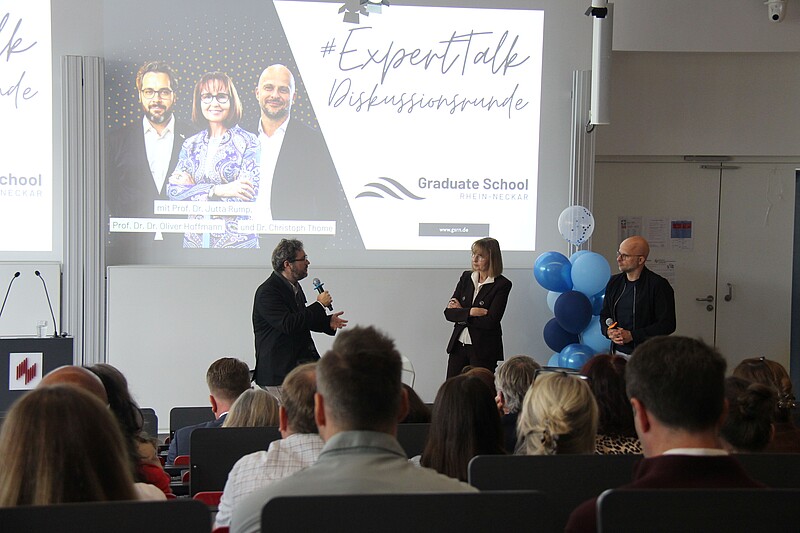
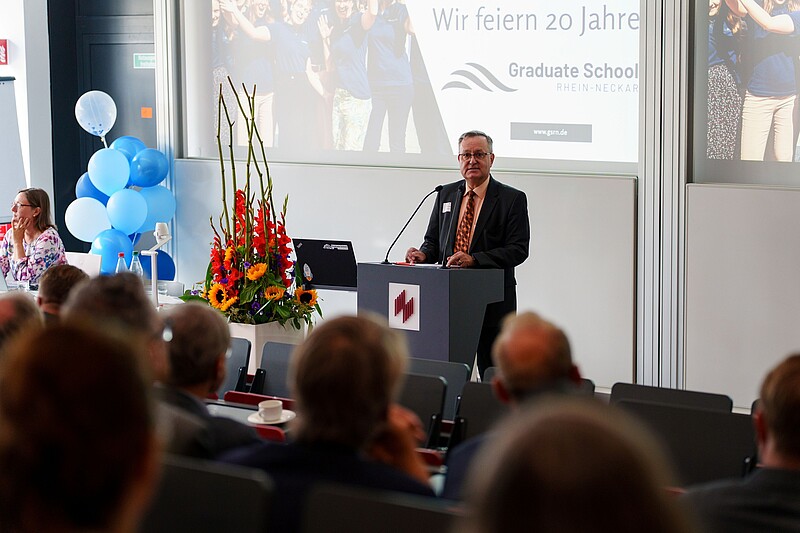
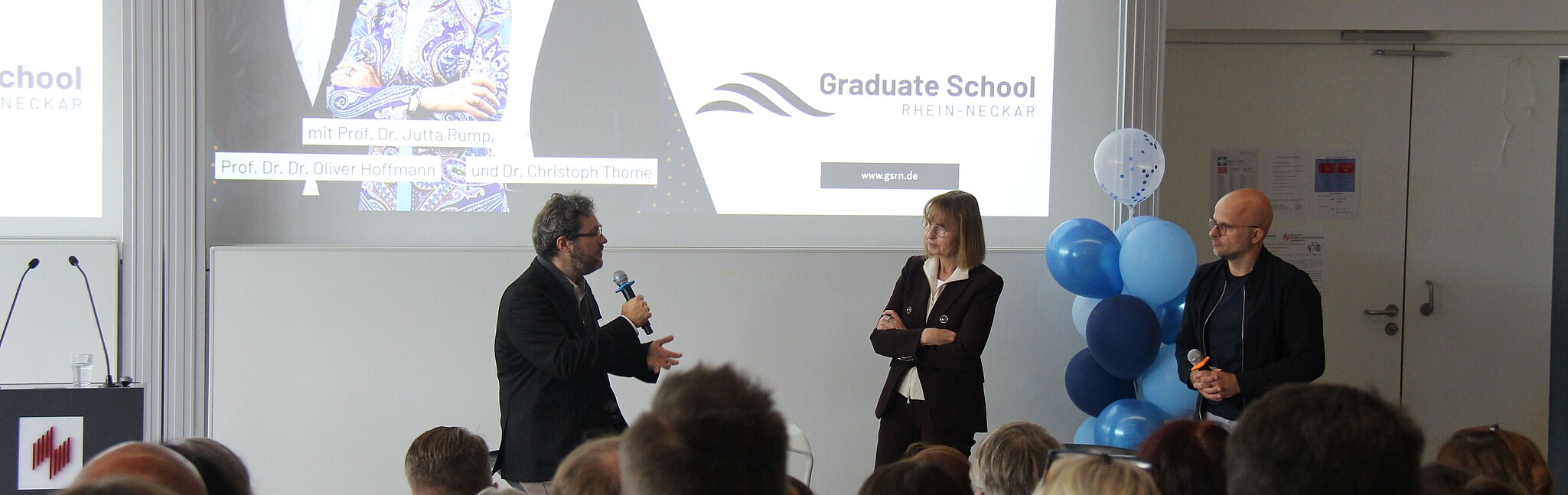
“An anniversary is not an endpoint, but rather a milestone—especially in education, given the rapid changes in our working world and society,” explained Ralf Blasek, Executive Director of the Graduate School Rhein-Neckar (GSRN), to the approximately 80 guests at last Friday’s anniversary event. Representatives from the region’s university administrations, the “metropolitan area Rhine-Neckar” association, the Palatinate Chamber of Industry and Commerce (IHK Pfalz), and the German Association for Small and Medium-Sized Businesses (BVMW), as well as guests from companies, faculty, and students accepted the invitation from the continuing education division of the Ludwigshafen University of Business and Society (HWG LU). “We are proud that our part-time continuing education programs have been continuously adapted to market needs and further developed to meet ever-changing practical requirements for over twenty years,” emphasized Gunther Piller, President of HWG LU, in his speech. The question of the future of the working world was accordingly the focus of the morning’s proceedings. In a panel discussion on the topic of humans and artificial intelligence (AI), Jutta Rump, professor of human resource management and director of the Institute for Employment and Employability at HWG LU, along with Oliver Hoffmann, a business and innovation psychologist and professor in London, shared the latest findings from their research. Moderator Christoph Thome from the FC Group in Karlsruhe posed practical questions grounded in real-world experience. This was followed by the anniversary celebrations.
Staying in Motion Without Losing Balance
First, Jutta Rump highlighted the wide range of transformations we are currently experiencing in the areas of digitalization, ecology, the economy, demographics, and society. Digitalization alone is triggering seven different effects in the world of work. Processes are being optimized and taken over by AI, which is displacing entry-level workers from simpler, routine tasks. At the same time, while we are gaining time thanks to the use of AI, this is raising performance expectations and intensifying the workload. Experienced professionals, on the other hand, are in demand for tasks that AI cannot take over, such as responsibility, decision-making, and coordination. She identified eight competencies of human intelligence (HI) as essential for the future. In the future, she said, leaders would play a key multidimensional role. According to her research, it is important that they understand the logic of digital systems, maintain a balance between efficiency and humanity, facilitate learning and skill development for themselves and others, and provide guidance and psychological security.
Human Value Creation Lies in Responsibility and Judgment
The availability of an individual’s mental capacity and cognitive abilities was the focus of Oliver Hoffmann’s presentation. From a psychological perspective, mental resources such as attention and self-regulation are often overlooked in the workplace. The problem, he argued, is not the abundance of information, but rather the ability to integrate it into our thinking and actions. AI produces information at ever-lower costs, while human assessment of that information becomes more expensive. Therefore, he believes an important competency is setting boundaries—a process in which the economic benefits of deploying mental resources are scrutinized. Atmospheric leadership creates psychological conditions that foster performance. In the future, human value creation will lie in areas where psychological processes are involved, such as responsibility, judgment, and social interpretation. Both experts foresee a major upheaval but remain confident that leadership teams could offer a solution and that humanity will find a way to regulate itself and establish a new social model.
Academic Continuing Education to Secure a Skilled Workforce for the Region
In his subsequent anniversary speech, Ralf Blasek emphasized the unique nature of the GSRN, which was originally founded by two universities of applied sciences—Mannheim and Ludwigshafen. At that time, in collaboration with the then-Corporate Advisory Board, the requirements derived from professional profiles were integrated into the academic curriculum across state borders. Gunther Piller explicitly thanked the Ministry of Science, Continuing Education, and Health in Rhineland-Palatinate, which has explicitly enshrined academic continuing education in the Higher Education Act and opened access to continuing education master’s programs for professionally qualified individuals. “The state is thereby sending an important signal for educational mobility and equity. Our university can thus act as a broadly based educational partner for securing a skilled workforce in the region,” said Piller. He thanked the Center for Distance Learning within the university consortium as a long-standing partner in organizing the MBA distance learning programs. Stefan Lacher, professor at HWG LU and program director for Digitalization and Innovation, described the GSRN as a place of mutual learning. Both faculty and students learn from one another. He noted that it is a rewarding challenge to pass on knowledge about methods, models, and structures—especially when students with professional experience remark after receiving their Degree that their career prior to the MBA was essentially like driving without a license.
At the champagne reception that followed, the networking guests met this year’s MBA graduates, dressed in their graduation gowns and caps, who had arrived for their graduation ceremony that same day. For them, armed with their degrees and newly acquired knowledge, a new phase of life begins, one marked by greater professional responsibility.
*****************************************
Editorial contact:
Graduate School Rhein-Neckar gGmbH
Iris Zimmermann – iris.zimmermann@ 8< SPAM protection, please remove >8 gsrn.de
Ernst-Boehe-Str. 4–6, 67059 Ludwigshafen
info@ 8< SPAM protection, please remove >8 gsrn.de| www.gsrn.de | Tel. +49 621 595 728 18
*****************************************
About the Graduate School Rhein-Neckar:
As a nonprofit continuing education institution affiliated with the Ludwigshafen University of Business and Society, the Graduate School Rhein-Neckar is a center of excellence for lifelong learning for students and professionals of all ages in the metropolitan area Rhine-Neckar. In an academic setting, university faculty and subject matter experts impart methodological knowledge based on current research and professional practice. Since its founding in August 2006, it has offered academic continuing education in small groups with personalized support. Its portfolio includes part-time MBA and Master’s degree programs leading to state-recognized degrees from Ludwigshafen University of Applied Sciences and Mannheim University of Applied Sciences, as well as shorter continuing education programs, professional development courses, and in-house training.