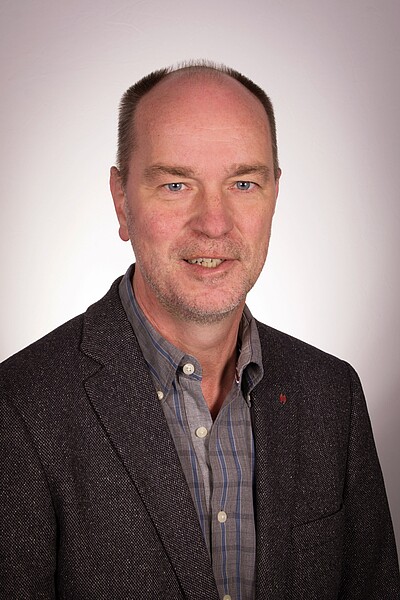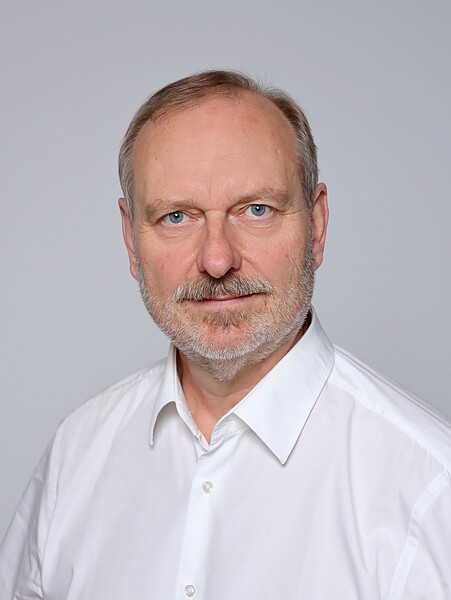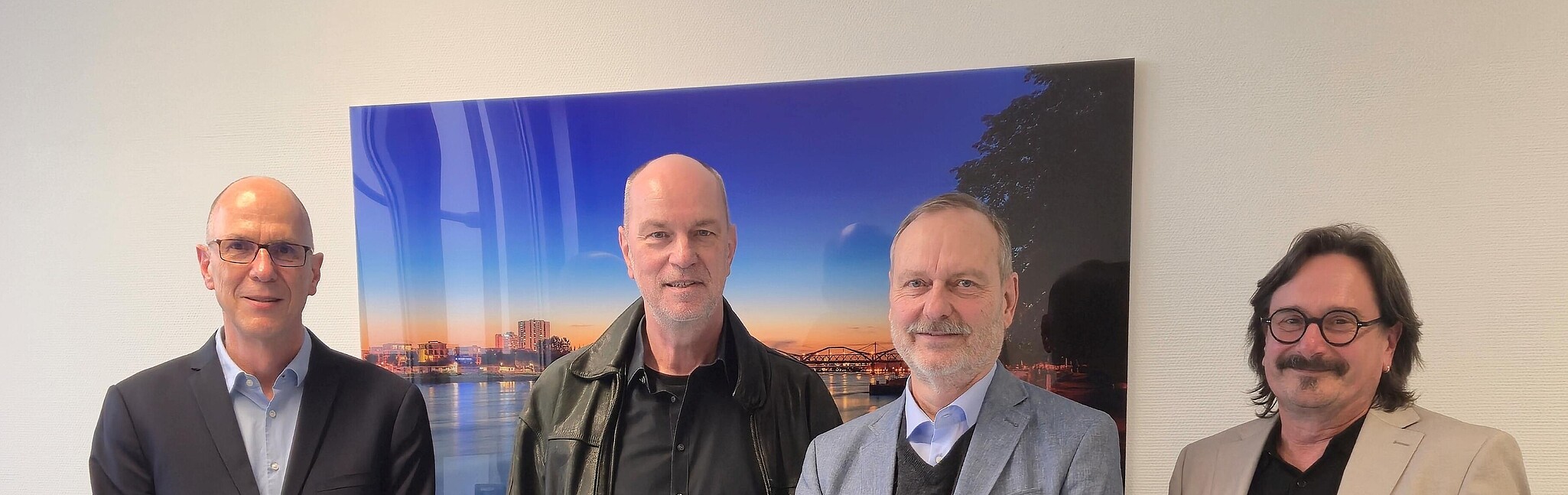
Prof. Dr. Arnd Götzelmann and Prof. Dr. Hans-Ulrich Dallmann, both theologians with habilitation, from the Department of Social and Health Services at the Ludwigshafen University of Business and Society and one of its two predecessor institutions, the Evangelical University of Applied Sciences in Ludwigshafen, before they retired in March 2026. With their departure, the university loses two dedicated faculty members, scholars, authors, and key contributors to higher education policy—who, among other things, actively supported the merger of the two Ludwigshafen universities of applied sciences in 2008 and the Department’s move from Maxstraße to Ernst-Boehe-Straße in 2024. In this interview, the two look back on the past decades and current developments.
You have spent nearly 30 and nearly 25 years, respectively, at the Evangelische Fachhochschule and HWG LU. Looking back, which events stand out to you as particularly memorable?
Dallmann: That would definitely be the beginning. Deutsche Bahn almost derailed my job application. I had chosen a train that was supposed to arrive an hour before my job interview. It was a hot day. The ICE then came to a stop on the tracks in front of Mannheim Central Station. At some point, an announcement came over the intercom that the main station was closed due to a disruption. We would now stop at Mannheim-Friedrichsfeld, where a regional train would be available shortly to take us onward. So there I was, standing on the platform with other passengers waiting to transfer. But no train ever showed up. Thirty years ago, cell phones weren’t a given either. Taxis? None in sight. Eventually, a train did arrive—it stopped at Ludwigshafen Central Station, ten minutes before my appointment. I jogged to the university and arrived just in time, out of breath and drenched in sweat.
The main topic, of course, was the merger, but we’ll get to that in a moment. Another point was the new construction project. After the merger, the ministry stated that planning could not even be considered until a university development plan had been submitted. This plan then had to be completed on an expedited basis, which—given the cultural differences between the two universities—was, to put it mildly, somewhat difficult. Consequently, the first draft wasn’t acceptable. I then compiled the least controversial points into a shorter version—essentially a stopgap measure for the overarching purpose. But a new university development plan has not yet been produced. That’s just how it goes with stopgap measures. In the meantime, I had stopped believing that a new building would ever be built, but fortunately, I was proven wrong. The State Court of Auditors was not solely responsible, but it did play a role in the lengthy planning and construction period. Although its staff participated in all planning meetings, the court repeatedly submitted requests for changes. That, combined with the bureaucratic structure of the LBB, delayed the process by years and ultimately cost millions.
One more of the many noteworthy events: the 2014 graduation celebration. It happened to clash with the World Cup quarterfinal between Germany and France. We managed to organize a “public viewing” at the Pfalzbau on relatively short notice; Ms. Sahmel from the university’s communications department was primarily responsible for making that happen at the time. It was a wonderful evening.
And most memorable of all are the colleagues who passed away far too soon during my time at the university. Klaus Priester, the most charismatic colleague I ever had the privilege of knowing; Ellen Bareis, with her clear, analytical perspective on the situation and always full of interesting ideas; and Monika Greening, who joined us during the COVID-19 pandemic and was a wonderful organizer—which was absolutely essential, especially when setting up the Skills Lab.
Götzelmann: I’d already been connected to the Protestant University of Applied Sciences since 1992, when I organized the Ludwigshafen City Church Convention—for which we also used the university building at Maxstr. 29 and developed a joint program. That was 34 years ago. Ten years later, I was appointed to the “Endowed Chair for Diakonia.” Not only did I begin to further develop connections with the Diakonisches Werk Pfalz—where I had worked as a continuing education coordinator—and with other diaconal organizations, but I also proposed to my faculty a modular system for master’s degree programs in the field of social and health services. It was not accepted. However, I soon succeeded in launching the master’s program “Management in the Social Welfare Sector” through a collaboration—spanning state borders and university types—with the University of Heidelberg (Prof. Dr. Heinz Schmidt, et al.) and Department I of what was then the Ludwigshafen University of Applied Sciences (Prof. Dr. Eveline Häusler, et al.). Together with the “Ludwigshafen University Consortium”—which was soon formed by our two local universities of applied sciences—it served as a valuable testing ground and a confidence-building measure for the subsequent integration of the Protestant University of Applied Sciences as the new, fourth Department of the state-run Ludwigshafen University of Applied Sciences. No sooner had I established myself as a professor at my Protestant University of Applied Sciences than an existential sense of uncertainty arose due to the ideas of the church-affiliated sponsoring organization to divest itself of its university, dissolve it, or transition it into a new cooperative arrangement. This also affected me personally. Although I very much enjoyed being a pastor in the congregation and in social welfare work, I had come to love my second profession as a professor of social work. Ultimately, the transition to the University of Applied Sciences for Business in 2008 was a good solution for me personally as well, even though I still consider the regional church’s decision to relinquish its sponsorship to be a mistake.
And what topics particularly preoccupied you in education and research during that time?
Götzelmann: After a year as an endowed professor of diaconal work, I was appointed to a tenured professorship in “Ethics, Diaconal Theology, and Social Policy” in 2003. The need for social policy was covered by other departments; diaconal studies no longer played a role after the “university merger.” But I always enjoyed teaching ethics in social work—and repeatedly in our health-related degree programs as well, and initially in Business Studies—and I learned a great deal from our former adjunct professor Dr. Gerhard Vidal and later from Hans-Ulrich Dallmann. I also enjoyed providing education in my specialization, “Social Work in the Context of Inclusion, Health, and Gerontology,” which students could choose from among eight options in their third semester. I really enjoyed the opportunity to guide a small group of students over four semesters and to combine academic research with professional practice within a growing network of collaborations. I regret that my Department has not yet sought a successor for the area of inclusion.
I was able to use my research leave semesters for my research projects. I focused on four main areas: Initially, I concentrated on topics in diaconal studies and pastoral psychology—including through symposia I organized myself, which resulted in several publications. After the merger, I turned my attention to the relationship between human rights and social work. Then I worked on a multi-year, no-budget project with Prof. Thomas Wagner on “Reflections on the Transformation of the Welfare State in Biographical Narratives about Everyday Professional Life in Diaconal Social Work.” My research project on the history of Protestant social work training institutions in the Palatinate since 1945 and on the Protestant University of Applied Sciences in Ludwigshafen since 1971 captivated me during my final years in the profession.
Dallmann: My position was titled “Theology/Social Ethics.” That was already an anachronism at the time of my appointment: Theology had not been taught at the EFH for a long time. For me, the greatest challenge was to establish the practical relevance of ethics to the fields of social work and health/nursing. My goal was to develop an ethics of “” in social work and nursing through education and research. This culminated in two textbooks: one on social work, which I published with a colleague and friend, and one on nursing, which I published with my wife, who is a nursing scientist. In addition, there were two main areas of focus: First, the incorporation of systems theory approaches into ethics and social work. This topic has interested me ever since my doctoral dissertation. Second, the topic of migration, which I addressed in depth in my habilitation thesis and which was central to my work during the early years of the “Social Work in the Context of Migration” program (previously known as “Work with Foreigners”—changes in terminology often have their benefits after all).
You also accompanied and helped shape the merger of what was then the Evangelical University of Applied Sciences and the University of Applied Sciences for Business, with their very different study programs and cultures. Looking back, how do you assess the merger?
Dallmann: Strictly speaking, it wasn’t a merger, but a transfer of operations under Section 613a of the German Civil Code (BGB). We at the EFH had been advocating for autonomy in the period leading up to it. We had also been looking into alternative merger options. The merger with the Protestant University of Applied Sciences in Darmstadt—which actually seemed like the most obvious choice—failed due to state and regional church boundaries. Some colleagues got the impression that the regional church wanted to get rid of us at any cost. In any case, looking back, I’m not the only one who views the regional church’s decision to divest itself of the university as a serious mistake. But the transition to state sponsorship opened up enormous opportunities for development at the university, which continued to exist solely as a Department. It is certainly doubtful whether the expansion of the health care sector—including midwifery and nursing—would have been possible had we remained under the regional church’s auspices. So, even if it was initially a “marriage of convenience,” it has proven its worth in the years since.
The merger of the two colleges was complicated by the fact that we at the EFH initially remained (for a total of 16 years) in the old building on Maxstraße. Collaboration therefore took place primarily at the administrative level; in day-to-day education and research, there were only a few joint initiatives, such as the interdisciplinary module on Refugees and Migration and a few collaborations on a personal level, including those related to the Social Innovation Lab in the city center. All in all, however, this remained fairly limited. And the “cultural” differences between the various academic and social milieus cannot be overlooked. A large part of my role as vice president and on the university leadership team was to translate and mediate between the different “dialects.” It should come as no surprise, for example, that the term “quality management” evokes very different associations.
It is to be hoped that the shared campus will foster this coming together. In addition, many young colleagues have joined us since then for whom the EFH is a thing of the past. Surely, one thing or another should be possible.
Götzelmann: As I briefly mentioned earlier, the transfer of the Evangelical University of Applied Sciences (EFH) to the state university in Ludwigshafen ensured the continued existence of our degree programs, our staff, and—for a long time—our accommodation at Maxstr. 29. Furthermore, it seemed to open up many new opportunities. We haven’t really taken full advantage of them. For example, we were unable to revive our “Institute for Continuing Education, Counseling, and Research”—which had been operating very successfully at the EFH for a long time—under the new umbrella of the state university of applied sciences. Under Dean Hans Ebli, there were at least some promising initiatives in this regard. For a long time, we were not properly included in the research funding of the joint university of applied sciences. The different traditions, cultures, and areas of expertise of the two universities of applied sciences, combined with the physical separation—which did not end until 2024 with the move to the shared campus—led to “parallel universes” within the merged institution, even though there were many commonalities, productive interactions with individual colleagues, and our people—Hans-Ulrich Dallmann’s involvement in the university administration since 2008 deserves special mention here—did indeed serve on all joint committees. Often, however, we were and remained a minority, dominated by the majority from the three “old Departments” with an economic focus, even though Presidents Wolfgang Anders and Peter Mudra had recognized the opportunities that our Department of Social and Health Services presented for the entire university and had also tried to capitalize on them.
How did you experience the move to the joint campus in 2024?
Dallmann: It dragged on. And quite literally, too; over the years, quite a bit had accumulated that needed to be disposed of or moved. It also dragged on because, at first, only the Social Work program was able to move. The Health Sciences department remained on Maxstraße because the new skills lab on Turmstraße wasn’t yet finished, and we had to use a temporary facility not far from Maxstraße. It was frustrating that the completion of the cafeteria took so long. That, too, makes the campus feel like a temporary arrangement.
Götzelmann: I see it exactly the same way. For me, there are two additional points. The good thing about the delayed move was that it ultimately happened so close to my retirement that, when I was clearing out my old office on Maxstraße, I was already discarding more than 90% of all my belongings. That made it easy for me to clear out the rest in preparation for my retirement in March 2026. The downside was that I now had to move into a shared office that was actually too small, after having had an office all to myself for almost my entire professional life. Familiar routines—such as advising students, meeting with colleagues and external parties, and making phone calls—came to an abrupt end or changed significantly. A feeling of demotion set in. The silver lining, however, was that my office partner, Prof. Andreas Rein, and I developed an extremely good working relationship—even a friendly one.
The Department of Social and Health Services, which emerged from the EFH, has also continued to evolve since 2008. Which developments do you consider particularly promising for the future?
Dallmann: The need for well-qualified professionals in social work, nursing, and midwifery will continue into the future. However, the way these qualifications are acquired is currently undergoing a major transformation. First the COVID-19 pandemic, then the rapid breakthrough of AI applications have drastically transformed studying and education in a very short time. The traditional, old-style on-campus university is in crisis. Some trends had already been emerging. For example, the number of students who (have to) work alongside their studies—in some cases to a considerable extent—has risen steadily, as has the number of those who (have to) provide care in private settings. Consequently, in-person attendance is declining, and the call for hybrid or online instruction is growing louder. This trend is further intensified by the fact that private educational providers are turning this need into a business model.
One response to this trend is the offering of dual degree programs. In this regard, I believe the Department is well-positioned following the launch of the dual degree program in social work and with its primary qualification degree programs in nursing and midwifery. As for the traditional degree program in social work, we’ll have to see to what extent it can be adapted to the changing circumstances—after all, it’s a state-regulated degree program, and the Department remains bound by certain constraints in some respects. The future of nursing education remains to be seen, but the department has been responding innovatively to these developments for some time now.
Götzelmann: The bachelor’s program in Social Work has been the university’s largest degree program from the very beginning to the present day. When I arrived, we had tried to expand it to include a new degree program in early childhood education and early childhood educator training. Unfortunately, the state then awarded the contract exclusively to “its” university of applied sciences in Koblenz. At least we managed to integrate this topic into the Bachelor’s in Social Work. Opportunities for collaboration at the important and broad intersection of social work and our nursing and midwifery programs could be further developed in the future. The health-related degree programs in our department are important and have developed well. Even back in the “Protestant era,” we had tried to establish academic programs for other health professions—such as physical therapy—in collaboration with various external partners. However, the state did not provide the positions or funding for this. I continue to see great potential for development here. Perhaps it would also be appealing to develop something similar—such as a qualification for leadership roles in social and health care—along the lines of the now-discontinued master’s program “Management in the Welfare Sector,” through another interdepartmental collaboration. I view the new dual degree programs with a critical eye: Because they are so closely tied to practical application, there is a risk that they focus more on “employability” than on scholarship.
Mr. Dallmann, you have particularly used ethical issues to build interdisciplinary bridges between social services and healthcare on the one hand and the economic sciences on the other. Was that successful?
Dallmann: Not really. That was certainly due in part to my own personality and position, but also to differing approaches. As I’ve already said, my primary focus is on ethics in social work and nursing. But ethics in the economic sciences is not ethics in business—it is business ethics, which is an important distinction. The focus here is less on reflecting on one’s own professional practice and its dilemmas, and more on the constitutive regulations and the legal and political constraints on economic activity. In a certain sense, social work, nursing, and midwifery are, by their very nature, ethically “contaminated” practices (with all the difficulties and problems that entails); this is not the case for economics in the same way. A concrete example: The classical principles of bioethics—namely, autonomy, beneficence, non-maleficence (i.e., the principle of doing no harm), and justice—are, at best, of peripheral importance to business ethics. Autonomy is not an issue because it is an axiomatic foundation of economic science and therefore cannot be called into question; beneficence plays no role, and non-maleficence plays virtually no role in economic calculations; and justice is the contingency principle of the legal system, not of the economy. In any case, I have not succeeded in bridging this gap.
Mr. Götzelmann, you have been and continue to be the chronicler of the history of social work in Ludwigshafen and at the EFH. Are you continuing your research on this topic?
Götzelmann: My work on this topic is complete with my latest book on the “History of the Evangelical University of Applied Sciences in Ludwigshafen” (2023) and a scholarly essay titled “On the Development of the Church-Run Social Seminar and University Building at Maxstraße 29 in Ludwigshafen” (2024). However, I would like to continue exploring the historical field through a project on family history.
What will you miss about the university?
Dallmann: The students and my colleagues; I can certainly do without committee meetings.
Götzelmann: Ditto, and the beautiful new library with its wonderful staff.
How will you fill the gap that’s been left?
Götzelmann: Even before retiring, my wife and I promised each other that we wouldn’t take on any new commitments for a year, but would instead think about what kind of involvement would be right for both of us—assuming we stay healthy. Right now, I feel that I want to move away from intellectual, academic, and theoretical pursuits and toward more musical, artistic, and practical ones. I enjoy playing the saxophone and singing, including in a project choir at our church. I’d like to do more musically. Last year, I started a painting class in Provence to rediscover watercolor painting, which I’d given up when I entered the workforce. There’s still room for improvement here. I also want to cycle and hike more. As soon as possible, I’d like to start volunteering as a rickshaw driver for seniors in Speyer. I might also take on the occasional book review. The future is wide open and full of wonderful possibilities.
Dallmann: For now, I’ve set aside an “orientation semester” to explore which areas I’d like to get involved in. I’ll simply continue with some things—my work in the church congregation and singing in the choir—and I won’t give up cycling either—and I’ll definitely keep going to the stadium. I’m sure I’ll also have more free time to cook. And I’ll definitely publish a piece or two. It’s highly likely (all that’s missing is the formal appointment) that I’ll be joining the team of patient advocates at the University Hospital in Frankfurt. Everything else will fall into place.
If you could offer some parting words to your former colleagues or the university administration—what advice would that be?
Dallmann: They’re doing great and certainly don’t need my advice. Except perhaps these lines from someone who just turned eighty: “Life goes on beyond the horizon.”
Götzelmann: Focus on the core processes of good education: staffing with faculty, scheduling classes, exam administration, and the like! Don’t fall into the trap of thinking, “There’s no business like show business!”
Thank you very much for the interview, and all the best!
(Interview: Elena Wassmann)