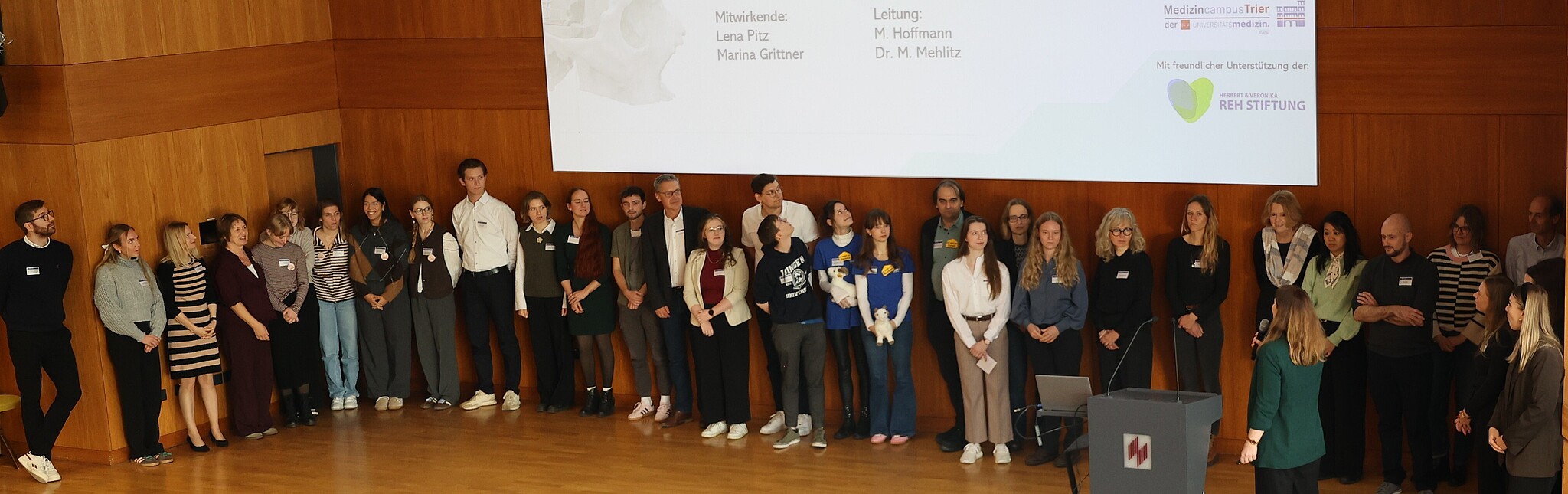
Young Researchers in the Spotlight: On October 22, 2026, in Ludwigshafen, eight universities of applied sciences (HAW) in Rhineland-Palatinate presented research projects by students and doctoral candidates.
Approximately 200 researchers, doctoral candidates, students, and those interested in science gathered at the Ludwigshafen University of Business and Society (HWG LU) on October 22, 2026, for the state-wide HAW Research Day. In addition to the host institution, HWG LU, the event included the University of Applied Sciences Kaiserslautern, the University of Applied Sciences Koblenz, the University of Applied Sciences Mainz, the University of Applied Sciences Trier, the University of Applied Sciences Worms, the Catholic University of Applied Sciences Mainz, and the Bingen University of Applied Sciences. Under the motto “The Future Is US – Science and Innovation in Rhineland-Palatinate,” this year’s event focused on the next generation of scientists.
“We are very pleased to be hosting the HAW Research Day here in Ludwigshafen—a day that all Rhineland-Palatinate universities of applied sciences planned together and are now organizing together,” said Prof. Dr. Gunther Piller, President of HWG LU, at the opening of the Research Day in the university’s auditorium. Research is a core mission of universities, he continued, and its results have a practical impact and directly contribute to the state’s innovation and sustainable future. “It is not a given that all universities of applied sciences in a state work together in constructive competition to further develop their research capabilities,” added Dr. Carola Zimmermann, Head of the Department of Research and University Construction at the Rhineland-Palatinate Ministry of Science, Continuing Education, and Health (MWWG), emphasizing the importance of applied research, particularly in meeting the needs of the regions. Zimmermann also noted that the state’s high-tech agenda, launched on Wednesday, sets the direction for future research priorities and represents an opportunity for the universities of applied sciences.
Eight Universities, Many Perspectives
Following the opening ceremony, the (vice) presidents for research presented a kaleidoscope of research and knowledge transfer activities at the universities participating in the HAW Research Day RLP: From migration research and impact assessment in the social and health sectors to building materials of the future and sustainable engineering materials, surgical simulation devices, sustainable agricultural and biosystems, and animal welfare research—all the way to analytical imaging techniques, micro- and nanotechnology in medical technology, cybersecurity and robotics, the security of the drug supply, sustainable energy supply, and hydrogen production from biomass—they highlighted a broad spectrum of application-oriented research areas: “Many perspectives for a shared future,” as Prof. Dr. Antje Liersch, Vice President for Research at Koblenz University of Applied Sciences, put it succinctly.
Student Research Project Pitch This diversity was also evident during the student research project pitch, in which students had just one minute to present their application-oriented research projects as a preview of the subsequent poster exhibition. Lena Pitz and Marina Grittner from Trier University of Applied Sciences kicked things off with a brief presentation of the modular training model HAMLET for neurosurgery, which allows medical staff to practice surgical procedures, such as tumor removal. This was followed by equally exciting short presentations, including one on “Digi-Ziege,” an app developed by Bingen University of Applied Sciences for automatic weight detection in goats to facilitate animal-welfare-promoting medication; the “Erfahrbar” project from Kaiserslautern University of Applied Sciences, which investigates distraction caused by phone use while driving, and the development of a multimodal and interoperable knowledge infrastructure for AI assistants, pitched by Marius Klein from the University of Applied Sciences in Mainz.
During the subsequent poster exhibition, participants engaged in conversation with the early-career researchers. There was also an opportunity to experience some project results firsthand, such as the model of a sustainable community center made of bamboo, which was built in the indigenous Mamanwa community in the Philippines and presented by Anna Reichelt from Kaiserslautern University of Applied Sciences. Projects from HWG LU were also well-received here, such as tests for the launch of a Bundesliga perfume in Asia or a tasting of the university’s own wine.
Doctoral Projects from Five Thematic Areas
The afternoon was then entirely devoted to current doctoral research: In parallel sessions moderated by the participating vice presidents for research, doctoral candidates, together with their supervising professors, presented their projects from the three newly approved, inter-university doctoral clusters in the state, as well as two additional subject areas. In the field of Biomedical and Environmental Life Sciences, for example, Anja Doeker from Bingen University of Applied Sciences presented her research project on wild herbs in Rhineland-Palatinate, and Irini Petrou from Kaiserslautern University of Applied Sciences gave a presentation on “Development of Microfluidic Filtration Platforms for Blood Sample Preparation and Cell Detection.” In the field of applied computer science, for example, Manuel Lofski from Worms University of Applied Sciences provided insight into his doctoral thesis on “Natural Physical Interaction with Virtual Humans,” while in the well-represented Economics section, for example, Celine Blettner and Marc Ritter from HWG LU presented their work on purchasing and consumer behavior. Emma Disselnmeyer from Worms University of Applied Sciences also gave a presentation on her doctoral dissertation, “Beyond the Visible: An Evidence-Based Impact Model for the Typology and Governance of Sex Tourism.”
Round two of the concurrent doctoral sessions was then dedicated to the fields of Sustainable Systems and Technology, Health and Social Sciences, and, once again, Economics: In the field of Sustainable Systems and Technology, Lukas Retterath from the University of Applied Sciences in Koblenz, among others, presented his doctoral thesis, which focuses on a contactless, rapid, and low-impact method for determining the surface hardness of steel using laser spectroscopy. In the field of Health and Social Sciences, the Mainz University of Applied Sciences (KH Mainz) was strongly represented with research on the therapeutic relationship in speech therapy, career trajectories for HAW professorships in the health sector, and the promotion of team resilience among hospital staff. In Round 2 of the economics doctoral presentations, for example, An Thi Thuy Vo from Worms University of Applied Sciences provided insight into “traffic distribution in European airspace,” while Mainz University of Applied Sciences presented on the work of the VORAN Research College, which aims to strengthen the focus on sustainability in business and society. Another doctoral dissertation from Mainz University of Applied Sciences also addressed the “lecture hall of the future” and “immersive technologies in higher education.”
Panel Discussion: Career Paths After a HAW Doctorate
To conclude the Research Day, former and prospective HAW doctoral candidates discussed their individual career paths: Dr. Florian Diller, acting professor at Worms University of Applied Sciences; Prof. Mirjam Gauch, tandem professor at the Catholic University of Applied Sciences in Mainz and the University Medical Center Mannheim; Prof. Dr. Marcel Hauck, professor of media informatics at Mainz University of Applied Sciences and technical project manager at Südwestrundfunk; Prof. Dr. Stefan Lacher, Professor of Business Administration with a focus on innovation management and digital transformation at HWG LU; Dr.-Ing. Christopher Petry, co-founder and technical authority at TENTA VISION GmbH; Dr.-Ing. Carsten Räch, Head of Electrical Engineering at Vision Electric Super Conductors GmbH, and Dr. Julia Trautwein, Technical Specialist for Animal Nutrition Europe at BASF SE, provided insights into their academic and professional careers. The discussion was moderated by Prof. Dr. Gerhard Raab, Professor of Business Administration—with a focus on marketing and business psychology—at HWG LU.
It was striking how often the panelists described their path to a doctorate as having “just happened”: a career in academia was not always a foregone conclusion from the start. Rather, it was professional curiosity, an exciting topic, personal recommendations, or a suitable opportunity that tipped the scales. The subsequent career paths were just as diverse—ranging from remaining with a company after completing a part-time doctoral degree, to returning to the academic world as a professor, to founding a company. The panelists agreed that, in addition to enthusiasm for one’s own topic, a supportive personal and professional environment is crucial. They also noted that maintaining contact with research and engaging with professional practice are important prerequisites for a future professorship at the University of Applied Sciences. Prof. Dr. Marcel Hauck summed up his advice for early-career researchers: “From the very beginning, choose a topic you’re passionate about.”
“Market of Opportunities” During breaks, participants could visit the information booths at the “Market of Opportunities” to learn about the qualification programs offered by the doctoral clusters, support services provided by the universities’ startup offices, and collaborative projects.
Conclusion
The Research Day demonstrated just how diverse applied research is in Rhineland-Palatinate—and just how much potential lies within the next generation of researchers at the universities of applied sciences. In his closing remarks, Prof. Dr. Gunther Piller thanked the participants from all universities, without whose commitment such a successful event would not have been possible. The location of the next statewide HAW Research Day in two years is still to be determined.
All presentations and program items can be found at www.hwg-lu.de/haw-forschungstag-2026
Contact:
Ludwigshafen University of Business and Society
Center for Research and Cooperation (ZFK)
Janina Kaiser/Claudia Wingerter
janina.kaiser@ 8< SPAM protection, please remove >8 hwg-lu.de / claudia.wingerter@hwg-lu.de


