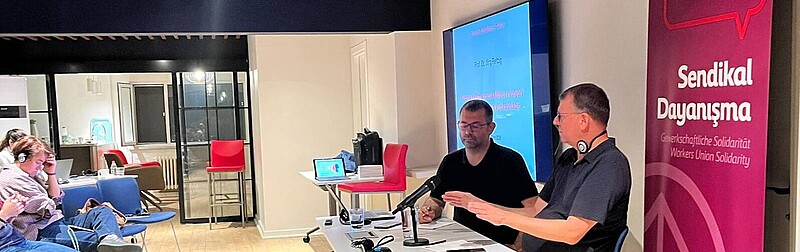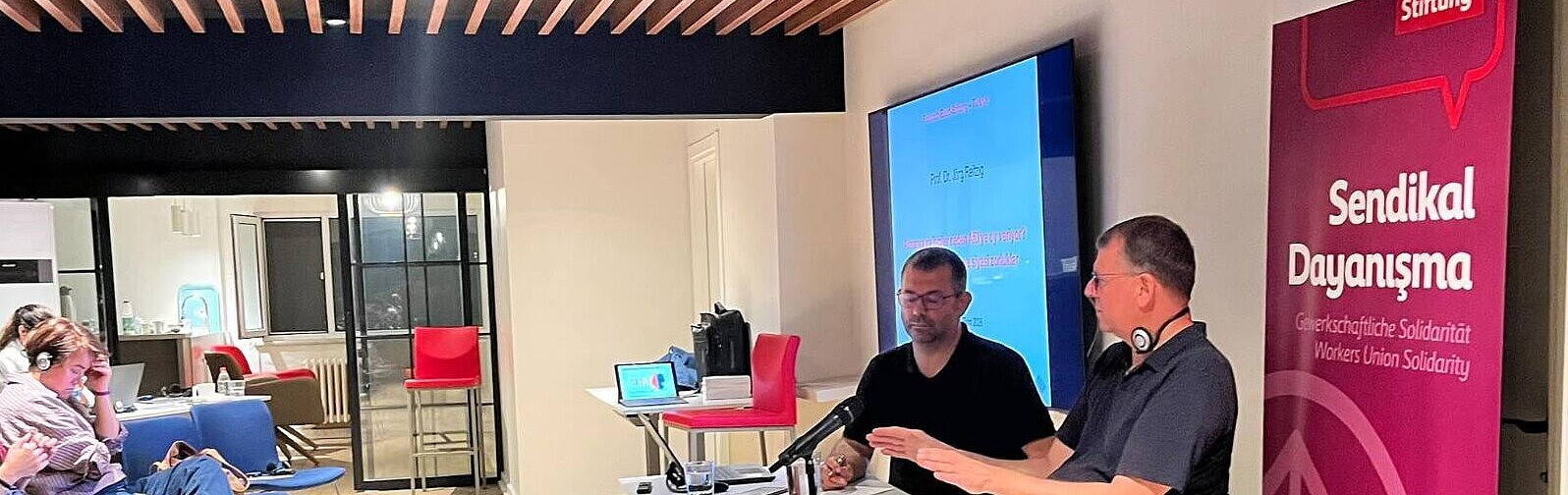
At the invitation of the Friedrich Ebert Foundation (FES) in Turkey, Jörg Reitzig, professor of social economics and social policy in the Department of Social and Health Services, gave a lecture in Istanbul on October 8 on the causes of the AfD’s electoral successes in Germany. The lecture addressed the question of how fears of economic decline and attitudes toward migrants influence the political preferences of blue-collar workers and white-collar employees —and why some members of these groups are turning away from left-wing and social democratic parties to vote for a party suspected of being far-right and, in some quarters, even considered definitively far-right.
The invitation to the evening event at the FES premises was accepted by numerous politically engaged individuals, union members, human rights activists, and scholars. In his lecture, Prof. Reitzig explained, among other things, how growing social inequality—particularly with regard to the distribution of wealth—serves as a breeding ground for right-wing populist forces such as the AfD. He also emphasized that social security and the redistribution of wealth are central issues for the future of the welfare state and for effective social anti-fascism.
The ensuing discussion was marked by numerous passionate contributions and a high level of factual knowledge. It revealed not only a keen interest in political developments in Germany but also a growing concern among many participants, who, due to personal or family ties to Germany, are following current events with particular attention.
As part of the visit, an in-depth roundtable discussion was also held with the speakers and the leadership of the FES’s Turkish office abroad, during which staff members from the Ankara office joined via video conference. The discussion focused on issues related to sociopolitical developments and the challenges facing labor unions in Germany. The Friedrich Ebert Foundation was founded in 1925, making it Germany’s oldest political foundation. It sees itself as part of the tradition of the labor movement and pursues the ideal of social democracy, which it actively promotes through its work in Germany and at its numerous international offices worldwide.