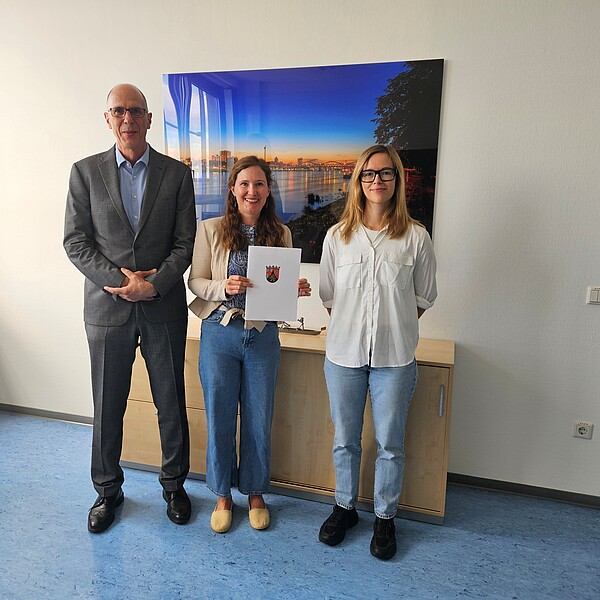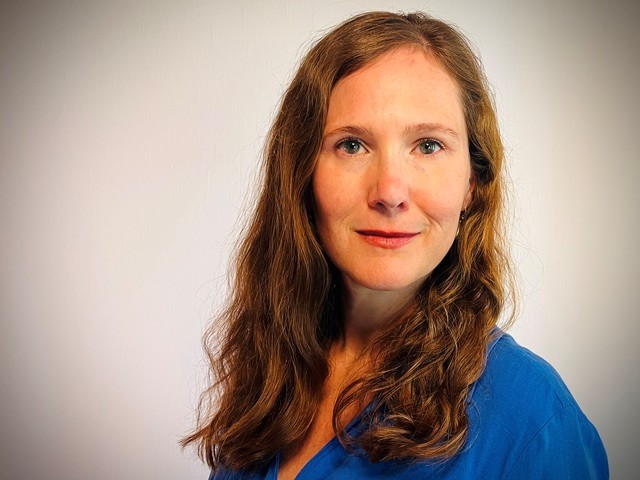
On September 1, 2026, Prof. Dr. Teresa A. K. Kaya (born 1984) began her tenure as a professor of ethics in the Department of Social and Health Services, teaching across all degree programs. Kaya began studying media and communication studies, American studies, and gender studies at the Universities of Mannheim and Marburg in 2005. She completed her European Master of Arts in Diaconia between 2009 and 2012 as a joint degree at Heidelberg University and Charles University in Prague, in cooperation with the Ludwigsburg University of Applied Sciences, the Darmstadt University of Applied Sciences, and the Freiburg University of Applied Sciences. In 2017, she earned her Ph.D. from the University of Heidelberg with a dissertation titled “Diakonia, American Style: History and Profile of Lutheran Social Ministry in the USA.” During her undergraduate and doctoral studies, she spent several stays abroad in the United States, supported by scholarships from the DAAD and the Hanns Seidel Foundation, and also worked at the National Theater in Mannheim as an assistant director and production manager. After conducting research as a research associate at the Institute for Diaconal Studies at the University of Heidelberg, Prof. Dr. Teresa A. K. Kaya provided education in social work with a focus on diaconal action in 2022 and 2023 at the CVJM University in Kassel, now known as the Protestant University of Applied Sciences in Hesse. In the winter semester of 2023–24, she joined Fresenius University of Applied Sciences in Heidelberg as a professor of social work, where she later also assumed the role of program director. Here, Prof. Dr. Teresa A. K. Kaya—who is also trained as a dance and movement therapist and educator, as well as a (teaching) trainer in biographical work—introduces herself in her new role as Professor of Ethics in Social and Health Care.
A warm welcome to HWG LU! You bring with you a diverse professional background and a variety of perspectives. To start off: How did you come to your current field of expertise?
In addition to a few semesters of Protestant theology, I studied media and communication studies, American studies, gender studies, and ultimately diaconal studies, including courses in religious studies. My curiosity about possible answers to ethical questions has always been the driving force. I’ve always found it fascinating that different disciplines offer different perspectives yet may be based on similar underlying questions.
In addition, several stays abroad were significant—I was in Prague on Erasmus and traveled to various parts of the United States multiple times for research. Here, too, the diversity of perspectives enriched me and broadened my horizons. I am currently a fellow at UC Berkeley until next fall.
What particularly appealed to you about the university and your new position?
I had been familiar with HWG LU for some time; word had spread about the Social Innovation Lab and the Department’s very well-equipped skills and simulation rooms. That piqued my curiosity. The Chair of Ethics in Social and Health Care addresses the full spectrum of ethical issues across all degree programs in the Department. That appealed to me and aligns with my interdisciplinary career path.
What experiences from your professional career so far are particularly valuable for your new professorship?
At first glance, my path may not seem very straightforward: From developing live concepts at an agency, collaborating on TV and theater productions, and teaching in educational settings, to working as a consultant for the nationwide Multigenerational House program and leading research projects, I’ve gained diverse insights into various fields across all generations. Most recently, I served as a professor of social work. Looking back, I wouldn’t want to have missed any of these stages of my career, and I hope to contribute to a diverse exploration of ethics as a cross-cutting issue.
What personally fascinates you about your field, and what aspects of it are often underestimated in public discourse?
Everyone has an opinion on ethical issues. Our intuition, the values instilled in us, religious worldviews, and role models—all of these influence our understanding of right and wrong. Professionals in the social and healthcare sectors face ever-changing ethical challenges in a unique way. They often have to make decisions—not infrequently existential ones—under time pressure while balancing conflicting priorities. This requires a solid ethical education as well as ongoing reflection and, in my view, deserves significant attention in both academia and practice.
Where do you currently see the greatest challenges for your field?
There are several key areas: the climate crisis, polarization, and extremism on the one hand, and spirituality and social cohesion on the other, to name just a few. But since you asked about the greatest challenges, I would say that the management of resources and existing structures of exploitation will occupy us ethically just as much as the responsible use of artificial intelligence in its various forms. At the same time—and I consider this fundamental—I see a need for reflection on personal and societal values.
What must future professionals learn today to be well-prepared for tomorrow’s workforce?
Critical thinking is a key competency that, as empirically demonstrated by the use of Large Language Models (LLM), we are increasingly losing unless we actively take countermeasures. This applies to both academia and professional practice. The ability to engage independently, reflectively, and skeptically with processes of thought and reasoning—in order to analyze information from various perspectives and make well-informed decisions—is, in my opinion, one of the most important things to learn.
What is particularly important to you in education?
It is important to me to help students develop a holistic approach that goes beyond subject-specific knowledge. Specifically, this means exploring topics using the “hand-heart-head” method and, in addition to the “head”—which is often the primary focus—more fully engaging the body and soul. There are excellent initiatives in higher education pedagogy in this regard, such as “Movement-Based Education” in the Heidelberg Model or “Grounding Techniques” from the U.S.
How do you handle it when different political or personal beliefs clash in education?
Differing opinions are not uncommon, especially when it comes to ethical stances and perspectives. Many people are accustomed to “airing” conflicts on social media. An experiment has shown that it’s significantly easier to post derogatory and insulting comments online than to discuss them with the person face-to-face. When conflict-prone situations arise in the education setting, it’s important to maintain a safe space. We are not operating in a vacuum here: the framework is established, there are regulations for the community, and the university’s mission statement. Discussion is encouraged, but it must be respectful.
In closing: What are your hopes for your time at HWG LU?
I hope for a productive space for exchange on equal footing, open interactions, and innovative projects—with students and colleagues as well as with industry partners, both locally, regionally, and internationally.
Thank you very much for the interview!
Interview: PE/Hoko